

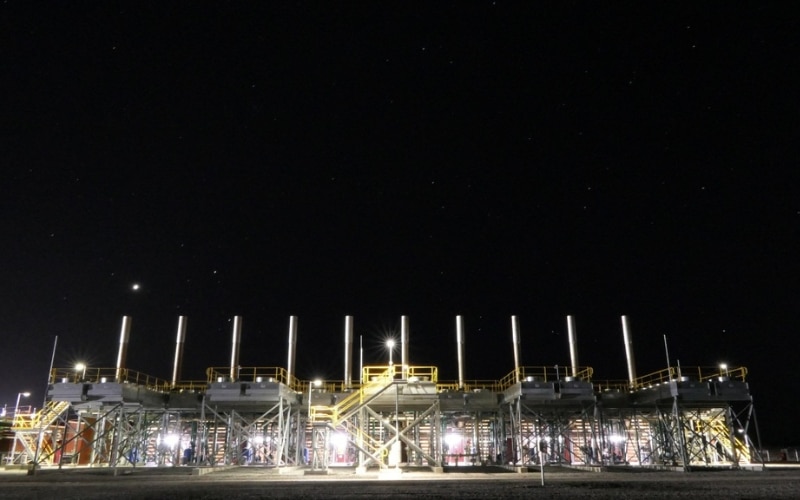
As data centers grow larger, more distributed, and more tightly coupled to grid constraints, onsite generation is no longer just a backup strategy. Gas engines are increasingly being evaluated for base-load or prime power, grid-parallel operation, and hybrid microgrids supporting artificial intelligence (AI) workloads and high-availability campuses.
Yet many energy models still assume one thing that rarely holds true in practice: steady-state, full-load operation.
In reality, most data centers spend a significant portion of their operating life at partial load. Understanding how gas engines behave away from 100% load is therefore essential to accurate performance modeling, cost forecasting, and resilience planning.
The Myth of Constant Full Load
Data centers are often designed for peak demand, but they are not operated at peak demand continuously.
Common operating realities include:
- Phased build-outs and modular commissioning
- AI and High-Performance Storage (HPS) clusters ramping unevenly
- Load migration between halls or campuses
- Maintenance windows and redundancy margins
- Interaction with batteries, uninterruptible power supply (UPS) systems, and grid signals
The result is a facility that may run at 40–70% load for extended periods, even if it is designed for much more.
This is where technology choice – and engine behavior – starts to matter.
How Gas Engines Respond to Load Changes
Gas engines are fundamentally different from gas turbines in how they handle varying load.
Key characteristics include:
- High electrical efficiency at partial load, often retaining a large proportion of full-load electrical efficiency down to 50–60% output
- Fast ramp rates, allowing engines to respond quickly to step changes in demand
- Modular scalability, enabling multiple engines to be staged on and off as load changes
Because each engine is a discrete unit, system efficiency can be optimized by running fewer engines closer to their optimal operating point, rather than operating one large machine inefficiently.
This makes gas engines particularly well suited to data-center environments with dynamic or evolving load profiles.
Partial Load vs. “Inefficient Operation” – A Common Misconception
Partial-load operation is often incorrectly equated with inefficiency.
In reality:
- Engines are designed with efficiency curves that remain relatively flat across a wide operating range
- Modern control systems manage air–fuel ratios, ignition timing, and turbocharging to maintain stable combustion
- Electrical efficiency degradation at partial load is typically modest compared to other generation technologies
When paired with battery energy storage systems (BESS), engines can be kept within their optimal operating bands while batteries absorb transients and short-duration peaks.
This hybrid approach is increasingly common in data-center microgrids.
Why This Matters for Data Center Economics
If partial-load behavior is not properly accounted for, several risks emerge:
- Fuel consumption is misestimated, leading to inaccurate operating cost forecasts
- Efficiency comparisons become misleading, especially when engines are compared to grid power or alternative technologies using different assumptions
- Resilience strategies are distorted, favoring fewer large units over multiple smaller ones without accounting for real operating flexibility
At scale, even small modeling errors can translate into millions of dollars over the life of a data-center campus.
Engines, UPS, and BESS: A System-Level View
Gas engines rarely operate in isolation in modern data centers.
They interact closely with:
- UPS systems that demand fast frequency and voltage stability
- BESS systems that handle instantaneous load steps and smoothing
- Control systems coordinating islanding, synchronization, and grid support
Engines that perform well under partial load – and tolerate frequent starts, stops, and load changes – integrate more effectively into these architectures.
This system-level compatibility is often more important than peak efficiency figures quoted at 100% load.
The Planning Implication
When evaluating onsite power for data centers, the key question is not:
“What is the efficiency at full load?”
But rather:
“How does the system behave across the load profile we will actually operate?”
That means:
- Modeling real operating ranges, not just nameplate ratings
- Understanding efficiency curves, not just single-point values
- Designing modular systems that scale with demand
- Aligning generation with storage and controls from day one
Final Thought
As data centers evolve from static facilities into dynamic energy consumers and producers, partial-load performance becomes a defining characteristic of good system design.
Gas engines, when properly specified and integrated, offer a level of operational flexibility that aligns closely with how data centers actually run — not just how they are modeled on paper.
And in a world where uptime, cost certainty, and scalability all matter, that difference is far from academic.
Want to learn more? Speak to the team at Clarke Energy.


