
There is frequent confusion of people familiar with diesel or gas engine operation, misunderstanding the meaning of two terms – “prime power” and “base-load” operation
Although the two terms are sometimes used interchangeably in casual conversation, they refer to different operating and rating conditions defined by engine manufacturers and standards bodies (ISO, IEC, NFPA, etc.).
Prime Power
Definition: Prime power is the rating given to an engine that supplies power for variable loads over an unlimited number of operating hours per year. It is designed for situations where the engine is the primary source of power, but the load is expected to fluctuate.
Key Characteristics:
- Variable load profile expected—engines must handle load swings, cycling, and non-steady demand.
- Unlimited run hours—the engine may operate continuously, but average load is not at the maximum rating.
- Typically rated at 10 percent lower output than standby ratings (to allow for continuous use).
- Used in locations without a reliable grid, or where a site intentionally runs engines to manage tariffs or fuel use.
- Maintenance schedules assume near-continuous operation under varying loads.
Typical applications:
- Remote industrial sites
- Mines
- Remote communities and islands
- Construction sites without grid access
- Facilities using engines as the main power source but not at constant, full output
Think of prime power as: Continuous operation with a variable load profile.
Base-Load (Continuous) Power
Definition: Base-load or continuous-power rating applies to engines that operate at a constant load level, close to their rated output, for extended or unlimited hours.
Key Characteristics:
- Constant or near-constant load, usually between 70–100 percent of rated capacity.
- Also designed for unlimited hours, but the duty cycle is steady.
- Often rated slightly lower than prime power to ensure longevity at constant high load.
- Focus on fuel efficiency, heat recovery (if CHP), and predictable maintenance intervals.
- Thermal recovery is often maximized, because stable load makes CHP predictable.
Typical applications:
- CHP plants (heating/cooling loads aligned with steady internal electrical demand)
- Industrial sites with stable baseload demand
- District heating/cooling networks
- Data centers relying on engines as temporary long-duration bridging power
- Grid-support plants providing firm capacity
Think of base load as: Continuous operation at steady, predictable load.
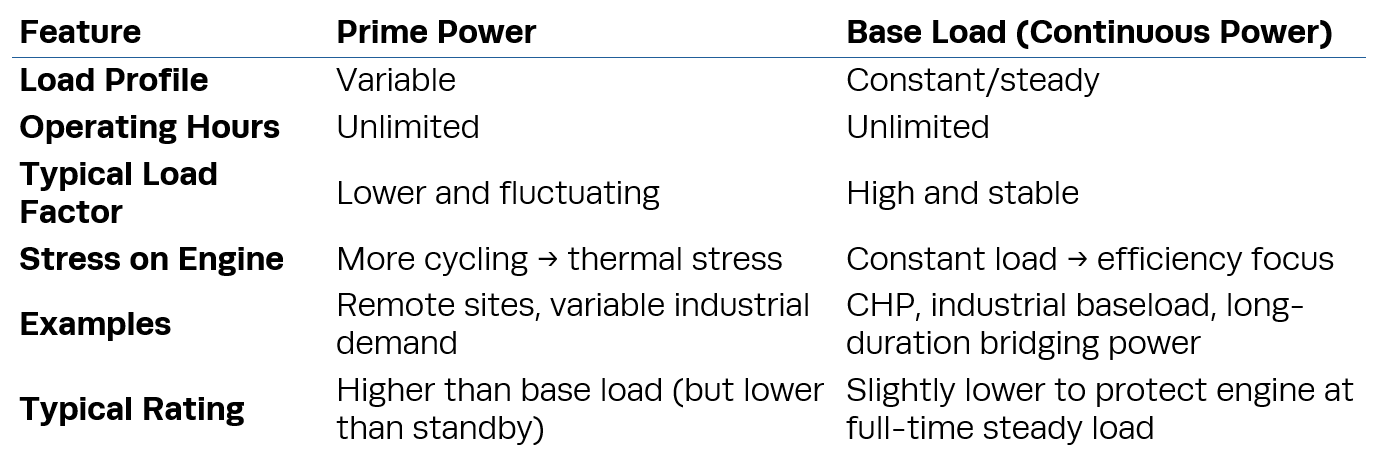
Key Differences at a Glance
Why This Matters for Data Centers
For data centers specifically:
- Prime power models the role where the engine is running regularly and carrying varying load depending on grid conditions or battery interactions (e.g., 4–12 hours per day with fluctuating AI loads).
- Base-load power applies when engines, typically gas engines, run continuously to meet the entire site demand—common in “bridging power” scenarios where a permanent grid connection is unavailable. These plants operate like mini power stations with predictable loading.
In other words:
- Prime power = flexibility and load-following.
- Base load = stability and efficiency.