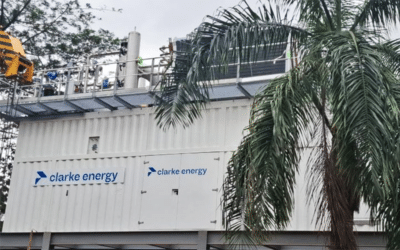

As renewable generation expands and electricity demand from AI accelerates, BESS is becoming essential infrastructure for the power systems of the future.

by Bob Beckwith, Group Applications Manager – BESS, Clarke Energy
For much of the last decade, Battery Energy Storage Systems (BESS) were viewed primarily through a commercial lens. Their value proposition centred on a relatively simple concept: charge when electricity prices were low, discharge when electricity prices were high, and capture the difference.
Success was measured in megawatt hours shifted and arbitrage revenue earned. That view is now rapidly becoming outdated.
As electricity systems transition towards higher levels of renewable generation, the role of utility-scale BESS is expanding far beyond energy trading.
In many markets, battery storage is evolving from a merchant asset class into a strategic infrastructure technology upon which future power systems will increasingly depend.
Grid operators are relying on batteries not simply to move energy through time, but to provide stability, flexibility, resilience and operational support that were historically delivered by conventional synchronous generation.
This shift is occurring against the backdrop of two simultaneous structural transformations: The first is the continued decarbonisation of electricity networks and the retirement of large synchronous power stations. The second is the rapid emergence of artificial intelligence and hyperscale digital infrastructure as major consumers of electricity. Together, these trends are reshaping both the supply and demand sides of the power system.
The future value of BESS will therefore be determined not only by the energy it stores, but by the critical infrastructure functions it performs.
In increasingly complex and dynamically operated power systems, batteries are becoming an essential enabler of grid stability, renewable integration, energy security and economic growth.
The Next Evolution of Battery Energy Storage
The first wave of BESS deployment was driven primarily by renewable energy integration. The second wave is being driven by the need for grid stability and system support as synchronous generation retires. The third wave may be accelerated by the convergence of artificial intelligence, hyperscale data-centre development and increasingly constrained electricity networks.
In this emerging landscape, battery storage is evolving beyond an energy asset into a strategic infrastructure platform positioned at the intersection of the energy transition and the digital economy.

Why Grid Operators Need Dynamic Support
Electricity grids have always required the continuous balancing of generation and demand. Historically, this was supported naturally by large synchronous generating stations equipped with spinning turbines and generators.
Beyond producing electricity, conventional thermal power stations provided a range of stabilising characteristics that were largely taken for granted. Their rotating machines inherently contributed inertia, supported frequency stability, provided fault current to strengthen network performance and assisted in maintaining voltage across the transmission system.
These services were effectively embedded within the generation fleet and delivered without the need for dedicated markets or procurement mechanisms.
As coal and gas generation retire and renewable penetration continues to increase, many of these inherent grid-support functions are disappearing. Wind and solar generation are connected through power electronics rather than directly coupled rotating machines and therefore do not naturally provide the same stabilising characteristics.
While this transition delivers significant environmental benefits, it also changes the operational requirements of the electricity system.
Grid disturbances occur within fractions of a second. Frequency deviations, voltage excursions and network faults require an immediate response to prevent wider system impacts. As traditional sources of stability decline, transmission system operators are increasingly seeking technologies capable of delivering these services through advanced controls and power electronics.
This is where BESS has emerged as a critical enabling technology. Battery systems can detect grid events and respond within milliseconds, significantly faster than conventional thermal generation.
By rapidly injecting or absorbing power, they can support frequency stability, improve system resilience and reduce the risk of disturbances escalating into wider network events.
As renewable penetration increases, this capability is evolving from a desirable asset characteristic into an essential requirement for maintaining secure grid operation.
Renewable Growth and the Challenge of Declining System Inertia
One of the most significant technical consequences of the energy transition is the decline of system inertia. Inertia is the stored kinetic energy contained within the rotating masses of synchronous generators and acts as a natural shock absorber that slows the rate of frequency change following major disturbances.
For decades, inertia was abundant. Coal, gas, nuclear and hydroelectric generators provided substantial rotating mass simply by being connected to the network. As these assets are progressively displaced by inverter-based renewable generation, the amount of available inertia falls, causing grid frequency to change more rapidly during disturbances.
This phenomenon, commonly measured through the Rate of Change of Frequency (RoCoF), is creating new operational challenges for system operators. Faster frequency excursions leave less time for corrective action and increase the likelihood of protection systems operating unnecessarily, potentially leading to the disconnection of generation or demand.
Several markets have already experienced periods of very low system inertia, prompting network operators to introduce new operating measures and invest in technologies that can restore essential stability characteristics.
In the UK and Ireland, as well as markets including Australia, Germany, Denmark and parts of the United States, transmission system operators have invested in synchronous condensers to improve inertia, short-circuit strength and fault current contribution.
These rotating machines provide many of the stabilising characteristics historically delivered by conventional generation and remain an important part of the transition strategy.
However, while synchronous condensers deliver valuable physical grid support, they do not provide the operational flexibility, fast active-power response or multi-service capability that battery energy storage systems can offer.
Consequently, many operators increasingly view the two technologies as complementary components of a broader grid-stability toolkit.
The long-term solution is unlikely to involve retaining ageing thermal generation solely for its stabilising characteristics. Instead, future grids will require technologies capable of reproducing many of these services while remaining compatible with a high renewable content energy system.
Through advanced controls, power electronics and increasingly sophisticated inverter technology, BESS can deliver forms of synthetic or virtual inertia, providing an immediate response to grid disturbances.
Although these capabilities are not physically identical to synchronous machine inertia, they can make a significant contribution to system stability and are becoming an increasingly important part of the architecture of high-renewable power systems.

The Critical Role of Inverter Technology
If batteries are becoming critical infrastructure, then inverters are becoming the brains of that infrastructure. The true value of a modern BESS is determined not only by the battery cells but by its power conversion and control systems.
Historically, most inverter-based resources operated using a grid-following approach. These systems synchronise with an already stable grid and inject power accordingly. As renewable penetration increases, however, grid-following technology alone becomes insufficient.
Future grids require assets capable of actively establishing and supporting grid conditions rather than simply responding to them. This is driving growing interest in grid-forming inverter technology.
Unlike conventional grid-following technologies, grid-forming inverters actively contribute to the establishment and maintenance of stable grid conditions. They can provide voltage reference signals, support operation in weak networks, enhance system strength and contribute forms of synthetic inertia.
Their ability to remain operational during grid disturbances and emulate aspects of synchronous machine behaviour makes them one of the most important enabling technologies for high-renewable power systems.
For system operators, these capabilities are increasingly attractive because they help replace services traditionally delivered by conventional generators. The industry is already seeing major demonstration projects and commercial deployments where grid-forming battery systems are being used to stabilise weak networks and support renewable integration.
As these technologies mature, inverter capability may become one of the primary differentiators between battery projects. The discussion will move beyond battery chemistry and duration towards system performance, controllability, and grid-support functionality.
Why Future BESS Projects May Be Valued More for Grid Services Than Arbitrage
The direction of travel is clear. As battery deployment continues to scale, arbitrage is likely to become more competitive and, in many markets, less lucrative on a standalone basis.
At the same time, the need for grid support services is increasing. Every additional increment of renewable generation increases the need for services that maintain system stability. Frequency control, voltage management, system strength, and fast reserve capability are no longer peripheral technical considerations but core operational requirements.
As power systems become increasingly dependent on inverter-based resources, capabilities such as synthetic inertia, black start readiness and network resilience are likely to command growing strategic and economic importance.
These services address fundamental operational needs rather than temporary market inefficiencies. Consequently, the highest-value battery projects of the future may not necessarily be those that move the most energy. Instead, they may be those that provide the greatest contribution to grid stability and reliability. This shift has important implications for developers, investors, OEMs, and operators.
As a result, project development priorities are likely to evolve significantly. The industry’s focus will increasingly shift towards inverter capability, control system sophistication, dynamic grid performance, and compliance with ever-more demanding grid codes.
Equally important will be a project’s ability to address local network constraints and deliver measurable system benefits at specific locations within the grid.
Markets may also evolve to place greater economic value on essential system services, creating longer-term and more predictable revenue opportunities compared with wholesale energy trading alone. In effect, batteries are undergoing a strategic reclassification.
Once viewed primarily as merchant energy assets, they are increasingly being recognised as essential infrastructure whose value lies in underpinning system reliability, enabling renewable integration and supporting national energy security objectives.
BESS, Artificial Intelligence (AI) and the Rise of Hyperscale Electricity Demand
While renewable energy has dominated electricity-sector discussions over the past decade, AI may become the defining demand-side force of the next.
The rapid growth of AI training models, cloud computing platforms and digital services is driving unprecedented investment in hyperscale data centres around the world. Unlike many traditional commercial loads, these facilities operate continuously, demand exceptional reliability and increasingly require power connections measured in hundreds of megawatts. In some cases, individual campuses are approaching electricity consumption levels comparable to those of medium-sized industrial facilities or entire towns.
For utilities and transmission system operators, this represents a significant new planning challenge. Network operators must simultaneously accommodate growing volumes of renewable generation, widespread electrification of transport and heating, and an emerging class of highly concentrated digital loads.
Historically, electricity demand growth was relatively predictable and broadly distributed across regions. Hyperscale data centres are changing that paradigm. Large concentrations of computing infrastructure can create significant localised transmission constraints, increase network reinforcement requirements and accelerate the need for new grid capacity.
Increasingly, grid planners must therefore consider not only where future generation will be located, but also where large-scale digital infrastructure will connect to the network. In many regions, artificial intelligence is becoming a major driver of transmission planning alongside renewable energy development itself.
From a strategic perspective, this creates a powerful new argument for battery storage investment.
The same systems that support renewable integration can also help accommodate the growth of digital infrastructure while reducing stress on constrained electricity networks.

BESS as the Interface Between Digital Infrastructure and the Grid
One of the most strategically important future roles for battery storage may be as a buffer layer between highly dynamic digital loads and the wider electricity system.
Data centres require exceptionally high levels of power quality and operational resilience. Even short-duration disturbances can have significant operational consequences, creating strong incentives for operators to deploy local energy infrastructure capable of responding instantly to changing conditions.
Battery systems are uniquely suited to this role. Their ability to inject or absorb power within milliseconds enables them to smooth demand fluctuations, support power quality, mitigate short-duration disturbances and reduce instantaneous stress on network infrastructure.
In effect, batteries can decouple the fast-moving operational requirements of digital infrastructure from the physical limitations of transmission and distribution networks.
This capability becomes particularly valuable as data-centre operators seek grid connections in regions where network capacity is constrained. Co-located BESS installations can reduce peak import requirements, support staged facility expansion and potentially defer costly transmission upgrades.
At the same time, the batteries themselves can continue to participate in ancillary-service and balancing markets, creating additional value streams.
Future site architectures may increasingly combine renewable generation, utility-scale battery storage and hyperscale computing facilities within a single integrated energy ecosystem.
In such configurations, batteries become more than storage assets. They become operational control assets that optimise energy flows between generation, demand and the grid.
For utilities, this creates an opportunity to improve network utilisation and manage increasingly complex load profiles. For data-centre developers, it enhances resilience and energy flexibility. For investors, it opens the possibility of infrastructure projects that benefit simultaneously from growth in renewable energy and growth in digital infrastructure.
As AI continues to reshape electricity demand, battery storage may emerge as one of the few technologies capable of supporting both sides of the equation: enabling higher penetration of renewable generation while accommodating the extraordinary power requirements of the digital economy.
To Conclude
The battery storage industry is entering a new phase of maturity. While energy arbitrage helped establish the commercial foundation for early deployments, the future role of BESS extends far beyond shifting megawatt hours from one period of the day to another.
As renewable generation replaces conventional synchronous plant, power systems require new sources of flexibility, resilience and stability.
Batteries, enabled by increasingly sophisticated inverter technology, are uniquely positioned to provide these capabilities while supporting the transition to a low-carbon electricity system.
At the same time, the emergence of artificial intelligence and hyperscale data-centre development is creating a new source of electricity demand growth that will place increasing pressure on network infrastructure.
Utilities and system operators must now navigate a future in which both generation and demand are becoming more complex, more dynamic and increasingly dependent on power electronics.
The most strategically important BESS projects of the next decade may therefore be valued not only for the energy they store, but for the infrastructure functions they perform.
Their ability to support grid stability, strengthen system resilience, facilitate renewable integration and enable digital infrastructure growth may ultimately prove more valuable than energy arbitrage alone.
The first wave of battery deployment was about storing energy. The next wave is about supporting the grid. The wave beyond that may be about enabling the simultaneous expansion of both the energy transition and the digital economy.
In that future, BESS is no longer simply a storage technology. It is becoming a cornerstone of modern power system infrastructure.
Find out more
If you’d like to learn more about flexible, scalable BESS solutions, contact Clarke Energy for more information.